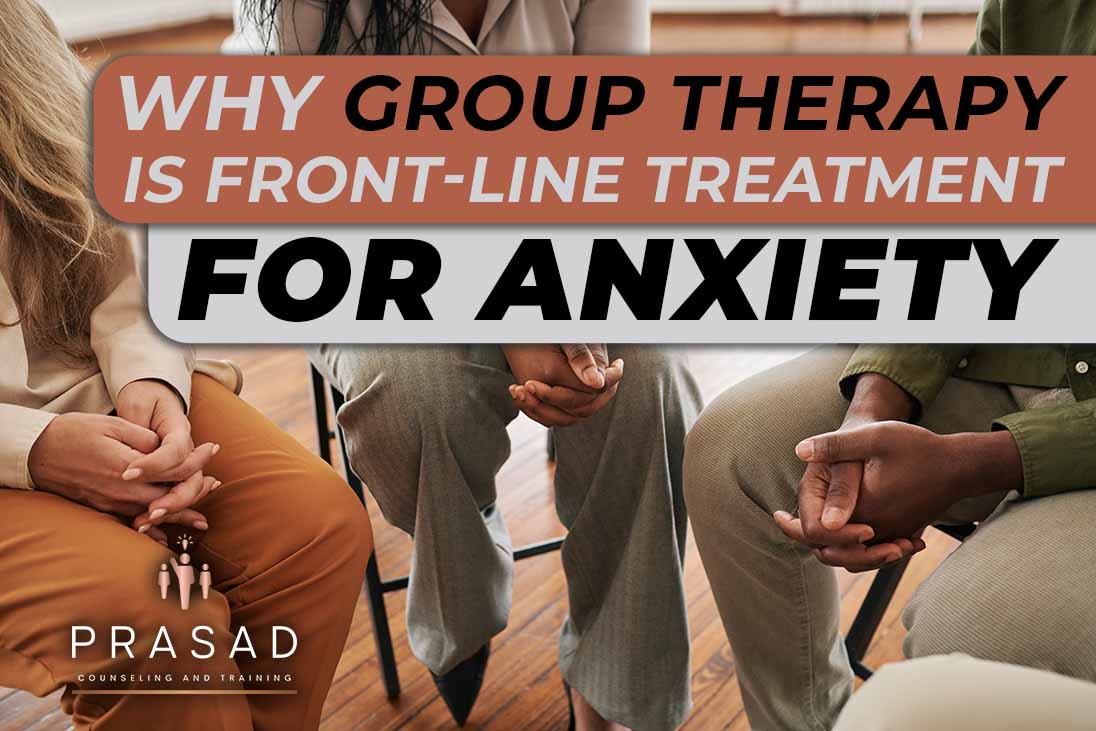
Why Group Psychotherapy Is a Front-Line Treatment for Anxiety
When people think about psychotherapy for anxiety, they usually picture sitting one-on-one with a therapist. Individual therapy is highly effective and remains one of the most common treatments for anxiety disorders. What surprises many people, however, is that group therapy is also considered a front-line, evidence-based treatment for anxiety. It is not just an adjunct or “extra” service.
Group Therapy: Facts vs Myths
Unfortunately, group psychotherapy has long suffered from misconceptions. Some believe it is only for people who cannot afford individual therapy, those with severe mental illness, or individuals who have not improved in individual counseling. The scientific evidence tells a very different story.
For decades, numerous studies have demonstrated that group psychotherapy is an effective treatment for anxiety disorders. In particular, research on cognitive behavioral group therapy has found outcomes that are generally comparable to individual cognitive behavioral therapy for many anxiety conditions. While one approach may be preferable for a particular diagnosis or individual, group psychotherapy has earned its place as a first-line treatment based on a substantial body of research.
Combining Individual with Group Therapy
At Prasad Counseling and Training, we often recommend combining individual and group psychotherapy because the two treatments complement one another in powerful ways.
Individual therapy provides a private setting to understand the origins of your anxiety, identify thinking patterns that keep it alive, develop practical coping strategies, and explore personal experiences that may contribute to your distress. It is an excellent place to gain insight, build self-awareness, and prepare for change.
Group psychotherapy allows you to take that learning into the real world—while still being supported by a trained therapist.

Benefits of Group Therapy
Think about learning to drive.
You could spend hours watching instructional videos, reading the driver’s handbook, discussing defensive driving techniques, and studying every traffic law. All that information is valuable and would certainly make you a more knowledgeable driver.
But eventually, you must get behind the wheel.
You have to merge into traffic, negotiate four-way stops, respond to unpredictable drivers, and make decisions in real time. Confidence is not built solely through discussion; it develops through experience.
Group psychotherapy works in much the same way.
Individual therapy helps you understand anxiety. Group therapy gives you the opportunity to experience anxiety while interacting with other people and to respond differently in the moment.
For many people with anxiety, that experience becomes transformational.
 Perhaps you notice your heart racing before speaking. Maybe you worry that others are judging you. You become self-conscious, overanalyze your words, avoid eye contact, apologize unnecessarily, or remain silent even when you have something important to say.
Rather than talking only about those experiences after they happen, group allows you to notice them as they unfold. Your therapist can help you understand what is happening internally, while fellow group members often provide honest, supportive feedback that challenges the assumptions anxiety has convinced you are true.
This is one reason process-oriented interpersonal group therapy can be so powerful.
Process Groups
Unlike groups that focus primarily on education or learning coping skills, process groups pay close attention to what is happening between members in the room.
Anxiety often shows itself in relationships long before we recognize it ourselves. We may fear rejection, avoid vulnerability, assume others are criticizing us, work excessively hard to please people, or withdraw whenever we feel emotionally exposed.
These interpersonal patterns are rarely unique to the therapy group. More often, they mirror the very patterns occurring with spouses, friends, family members, coworkers, and supervisors.
The group becomes a living laboratory where these patterns can be observed safely, understood compassionately, and gradually changed.
Enhancing Individual Counseling Sessions
What happens in group also enriches your individual therapy.
You might discover that you consistently compare yourself to others, assume people dislike you, become uncomfortable receiving compliments, or avoid expressing disagreement. Those observations become valuable material to explore more deeply during individual sessions.
Likewise, what you learn individually can immediately be practiced in group. Perhaps you’ve been working on challenging catastrophic thinking, becoming more assertive, tolerating uncertainty, or staying present during moments of anxiety. Group provides repeated opportunities to apply those skills with real people rather than simply imagining how you might respond.
The result is a continuous cycle of learning, practicing, reflecting, and growing.

Finding Support Among Others
Many clients are also surprised by one of the simplest but most healing aspects of group psychotherapy: realizing they are not alone.
Anxiety has a way of convincing people that everyone else is confident, composed, and emotionally healthier. Yet as members begin sharing openly, they often discover that others wrestle with remarkably similar fears, self-doubt, perfectionism, and uncertainty. That realization alone can reduce shame and foster self-compassion.
Group members also become witnesses to one another’s growth. They celebrate successes, offer encouragement during setbacks, and often notice progress long before individuals recognize it themselves. In many cases, helping another member face anxiety reinforces one’s own confidence and resilience.
Ultimately, the goal of treatment is not simply to reduce symptoms. It is to help people live more freely.
At Prasad Counseling and Training, we believe that lasting change occurs when insight is paired with experience. Individual psychotherapy helps clients understand themselves. Group psychotherapy provides the opportunity to put that understanding into practice within authentic human relationships. Together, these approaches create a powerful foundation for recovery.
If anxiety has been limiting your life, know that effective treatments are available.
The research is encouraging, and our experience has shown that many people achieve meaningful, lasting improvement through a thoughtful combination of individual and group psychotherapy.
Sometimes the greatest breakthrough comes not from talking about anxiety alone, but from facing it, while being supported by others and discovering that it no longer has to determine how you live.
Prasad Counseling and Trainings offers groups that meet in-person and virtually every other week. Contact us to learn more about the different solutions we have to support your mental health wellness journey.